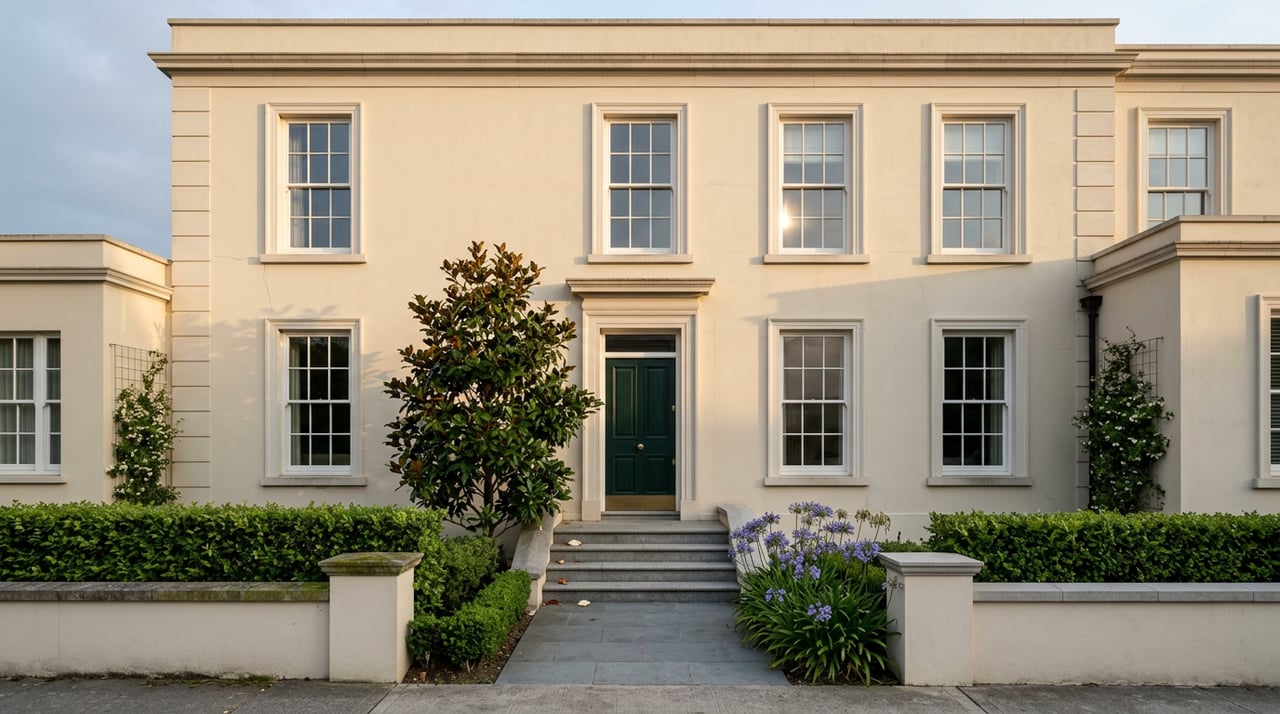
What happens if a buyer's best offer lands two thousand dollars past $5 million on your Pacific Heights listing?
The honest answer: your net proceeds can drop by more than $150,000, even though the sale price went up. San Francisco's documentary transfer tax does not scale gradually as a sale price climbs. It jumps. Once a sale crosses certain thresholds, the higher rate applies to the entire price, not just the portion above the line. A sale that closes at $4,999,999 and one that closes at $5,001,000 are separated by two thousand dollars in price and roughly $150,030 in tax. That is not a rounding error. That is a cliff, and this year it happens to run directly through the busiest price tier in Pacific Heights.
The tax that doesn't slope, it cliffs
San Francisco's transfer tax is collected by the Assessor-Recorder whenever a deed is recorded, and the rate is based on the full consideration paid for the property, not a flat rate no matter the price. The part that catches sellers off guard is that the schedule works on a threshold basis rather than a marginal one. Most people assume a higher rate only applies to the dollars above a cutoff, the way federal income tax brackets work. San Francisco's transfer tax does not work that way. Cross a threshold, and the entire sale price gets taxed at the new, higher rate.
Two real examples make the mechanic concrete:
- At the $5 million line, a sale that closes at $4,999,999 generates roughly $125,025 in transfer tax. A sale at $5,001,000, just $2,001 more, generates roughly $275,055. That is a swing of about $150,030 triggered by a price difference smaller than most people's monthly mortgage payment.
- At the $10 million line, the jump is smaller in dollar terms but still real. Crossing from $9,999,999 to $10,000,000 adds roughly $50,000 in tax, again applied to the full sale price rather than just the last dollar.
Because the transfer tax is customarily paid by the seller in San Francisco residential transactions, this cost lands directly on net proceeds. It is negotiable in a purchase agreement, and in competitive markets buyers sometimes offer to cover part of it, but the default expectation on both sides of the table is that the seller writes this check at closing.
Where that line falls in today's Pacific Heights market
This would be a footnote in a slow market. It is not a footnote right now.
As of data through mid-July 2026, the $3 million to $6 million range is the fastest-moving, most competitive price tier in Pacific Heights. Homes in that band are selling in around 10 days on market and routinely closing near 7 percent over asking, a sharper pace than the under-$1.5 million tier, which moves closer to 19 days and tends to settle near list price. Neighborhood-wide, Pacific Heights has been trading at a median just above $2 million with days on market roughly cut in half compared with a year earlier, but that headline number obscures how differently the market behaves once you isolate the $3 million to $6 million band specifically.
Put those two facts together and the picture sharpens. The single most active price segment in the neighborhood sits on either side of a tax line that can cost a seller six figures in a matter of dollars. A home listed at $4.95 million that draws the kind of bidding activity typical of this tier, several offers, roughly 7 percent over ask, does not just risk crossing $5 million. Given current conditions, it is close to expected.
A higher headline offer is not automatically the better offer once the $5 million line is in play. The math has to be run on both sides of the threshold before an agent tells a seller which number to accept.
This is the part a seller comparing offers needs someone to walk through in real time, not after the fact. An offer at $5.05 million looks like the clear winner next to an offer at $4.98 million until the transfer tax line is applied to both. Depending on exactly where each offer falls, the smaller headline number can produce a larger check at closing.
Why the rate itself might not hold steady
Pricing around a fixed threshold is one kind of friction. San Francisco is currently working through a second kind: the rate itself has been politically unsettled for most of 2026.
In February, Mayor Daniel Lurie and Supervisor Bilal Mahmood introduced the BUILD Act, a proposal that would have rolled the top transfer tax brackets, the ones affecting sales of $10 million and above, back toward pre-2020 levels, cutting the rate on $10 million to $25 million sales roughly in half and doing the same for sales above $25 million. The goal was to unstick stalled housing and commercial development. In June 2026, Lurie and Mahmood paused the plan. The city is facing a budget shortfall reported at roughly $936 million over the next two fiscal years, and Mission Local reported that Mahmood said the administration would not move forward on a tax cut until it had identified a way to replace the lost revenue. The existing rate structure, largely a product of a 2020 ballot measure, generated $324 million for the city's general fund between 2021 and 2024, and a controller's office estimate cited in that pause put the value of keeping the current rate at roughly $400 million more over the next few years, money officials were reluctant to give up mid-crisis.
At the same time, a separate and unrelated November 2026 ballot measure, the Affordable Housing Guarantee Act, is aiming to formally dedicate transfer tax revenue on large sales to affordable housing rather than the general fund. The San Francisco Standard reported that police and fire unions, along with Mayor Lurie, oppose the measure, arguing it would carve roughly $120 million a year out of funding for public safety services, while the measure's backers argue the city needs every housing dollar it can secure. Neither proposal changes today's rate for a $5 million to $6 million Pacific Heights sale. The BUILD Act only ever targeted the $10 million and above tiers. But for sellers at the very top of the neighborhood, homes like the Perry House on Jackson Street, listed earlier this year near $22.5 million, the rate that applies at closing is genuinely uncertain until these questions are resolved.
What to actually do before you set a list price
None of this is a reason to avoid pricing near these thresholds. It is a reason to price with the math already done.
A seller with a home valued between roughly $4.7 million and $5.6 million should see two complete net sheets before a list price goes live, one assuming the sale lands under $5 million and one assuming it lands over. The same logic applies at $10 million for the neighborhood's larger estates and multi-unit properties. Because the tax is based on full consideration and applies at recordation, the requirement to document any claimed exemption is not optional paperwork, it is the difference between a clean closing and a delayed one.
Sellers occasionally hear about structuring a sale as an entity transfer, selling the LLC that owns the property rather than the deed itself, as a way around the tax. San Francisco's change-in-ownership rules already treat a transfer of more than 50 percent control of an entity that owns city real property the same as a deed transfer for tax purposes. Attempting this without a real estate attorney and tax advisor reviewing the structure in detail is a way to trade a known cost for an unknown one, plus interest and penalties.
This is exactly the kind of pricing decision that benefits from a single advisor who is tracking both the deal in front of you and the policy environment around it, someone who can tell you not just what a home is worth, but what it will actually net once the deed records.
A few questions worth asking before you list
Does the buyer ever pay the transfer tax instead of the seller? It is negotiable and occasionally shifts in a purchase agreement, most often in a strong seller's market or with new construction, but the customary default in San Francisco residential sales is that the seller pays.
Do these thresholds apply the same way to a TIC or a multi-unit building? The transfer tax applies to the consideration paid regardless of ownership structure, so a tenancy-in-common sale or a multifamily disposition crossing $5 million or $10 million faces the identical cliff math as a single-family sale at the same price.
Could the rate actually change before my sale closes? Possibly, though not quickly. Any legislative rate cut requires a hold period, a budget hearing, and two votes by the Board of Supervisors, and the BUILD Act remains paused with no announced timeline for revisiting it. The November ballot measure targets revenue allocation, not the rate itself.
Pricing a Pacific Heights home near one of these lines is not a spreadsheet exercise you should be doing alone the week before a listing goes live. Amanda Jones Advisory works through both sides of the net sheet with every seller before a number goes on the door, and tracks the policy questions still moving through City Hall so a client is never surprised at the closing table. If your home sits anywhere near $5 million or $10 million, book a private consultation before you set the price, not after the offers come in.