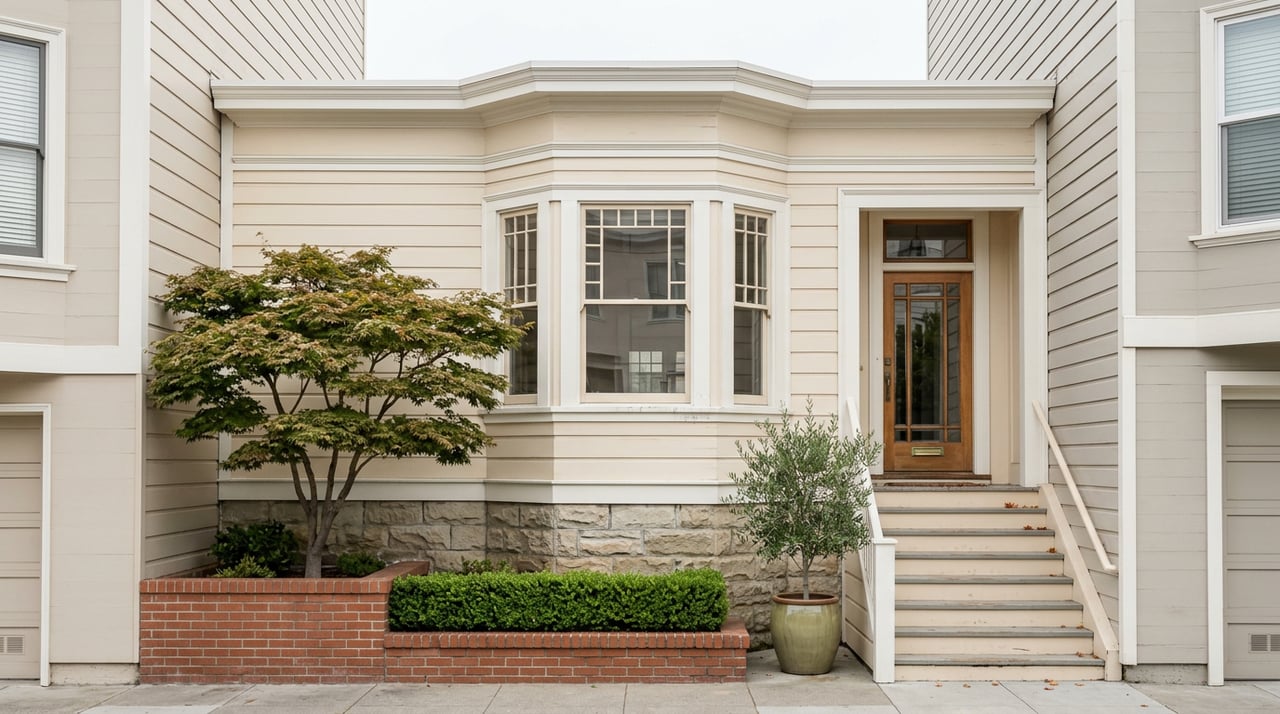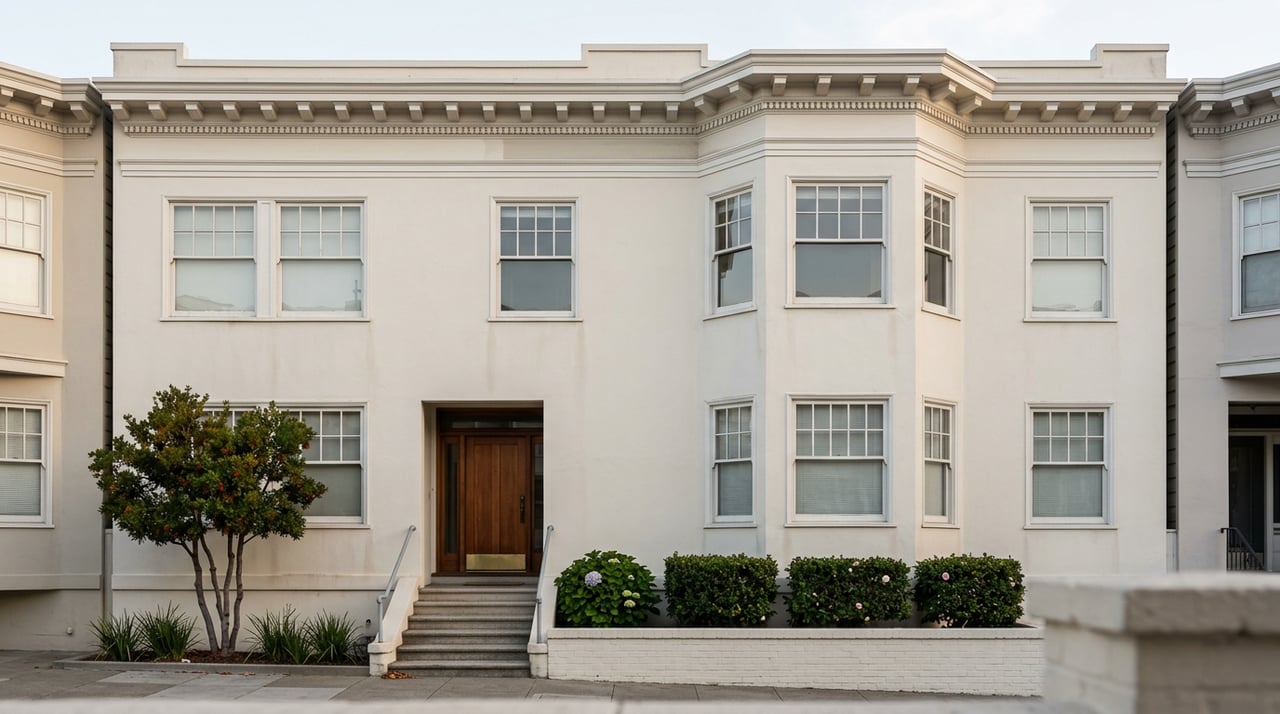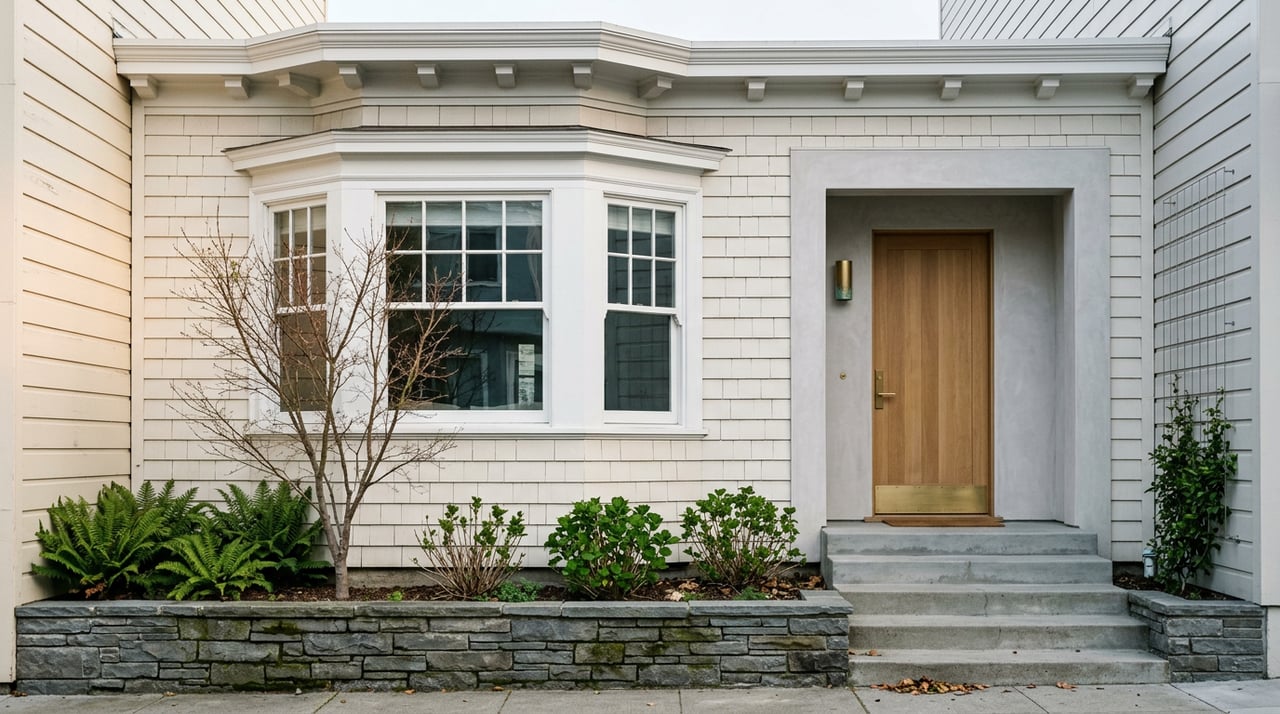
Walk Fillmore between Bush and Jackson right now and you can read the next twelve months in the plywood. A corner restaurant gutted. A dark theater marquee waiting for power. Sidewalk sandwich boards for a jazz festival that almost did not happen. A private golf club taking shape a block off the strip.
The easy read is that Upper Fillmore is "changing." That read misses the interesting part. What is happening on this three-block stretch is not organic neighborhood churn. It is a coordinated, privately capitalized reset, largely driven by two outside checkbooks, and it is landing on the same calendar quarter. If you live here, the fall of 2026 will be the moment the plan stops being a rumor and starts being a reservation.
Here is what to expect, corner by corner.
The corner that tells the whole story: 2001 Fillmore
The clearest signal of what the next Upper Fillmore looks like is the building at Fillmore and Pine. The ground floor sat dark for close to two years after Noosh closed, following earlier lives as Thai Stick and, before that, the long-beloved Pacific Heights Bar & Grill. That vacancy ends this fall.
The incoming tenant is Monami, a Korean barbecue concept from Junsoo and Hyunyoung Bae, the couple behind SSAL on upper Polk. SSAL holds a Michelin star, which is worth pausing on: this is not a first-time operator hoping the Fillmore address does the work. It is a proven kitchen opening a second, larger room aimed squarely at the neighborhood's expense-account dinner crowd.
Chef Bae has been direct about the ambition. He told the Chronicle he wants Monami to be a Korean barbecue version of House of Prime Rib, which tells you almost everything about the scale and the theater of the room he is building.
The building itself is telling a second story. Upstairs tenants, a mix of hair stylists, an acupuncturist, an aesthetician, a milliner and a marketing consultant, received notices on April 24 that they had to vacate by the end of May to accommodate ground-floor construction beginning June 1. Roof replacement is part of the scope. That is a level of build-out most restaurant refits do not touch.
None of this is happening in isolation. The property sits inside the Upper Fillmore Revitalization Project spearheaded by venture capitalist Neil Mehta, who has been quietly acquiring buildings along a three-block stretch of Fillmore since 2024. The 2001 Fillmore project is one of at least half a dozen sites moving through his portfolio at once.
The Clay, on paper and in practice
The second reset is one street closer to Broadway. On April 1, 2026, San Francisco's Historic Preservation Commission gave unanimous approval to the restoration of the Clay Theatre. That vote is what turned the Clay from a boarded facade into an actual construction project.
The approved scope is more ambitious than a nostalgic re-lighting of the marquee. Project director Cody Allen has described a program that runs seven days a week with more than 500 screenings a year, including independent releases, repertory programming, and 35mm presentation. The physical plan includes:
- Seismic upgrades to the 1910 building shell
- New projection and sound systems throughout
- A restored 200-seat auditorium with a reconfigured stage
- A lobby cafe with seating and an in-house bookstore
- An all-day restaurant in the corner commercial space immediately north of the theater, developed as part of the same project
Read that list against the Landmark-era Clay most residents remember, a single-screen art house with a matinee ticket you could buy for eight dollars. The new operation is closer in DNA to New York's Metrograph, which Mehta has publicly cited as the reference point. That is a different business, aimed at a different evening. Whether it works or not, the Clay will no longer be a place you drop into for a documentary on a Tuesday. It will be a booked evening.
The Fillmore Jazz Festival, and how close it came to not returning
The July 4 weekend just past looked, at street level, like the festival Fillmore has hosted since 1986. It nearly was not.
In 2025, organizers announced the festival was canceled over a funding gap of roughly $400,000 for annual operating costs. It was revived within days, underwritten by crypto founder Chris Larsen and his nonprofit Avenue Greenlight, along with additional community sponsors. That rescue is worth naming, because the 2026 version was not just restored, it was scaled up.
What returned this year included three main stages, more than twenty-five local and national performers, and stages named for Miles Davis, John Coltrane, Tony Bennett, and Johnny Mathis. If you have lived on the block for a decade, you noticed the difference: more stages, more crowd, a bigger footprint on the street closure. The through-line with everything else on Fillmore is the same. The festival is no longer funded the way it was before. Its scale is now tied to private philanthropy, which means its shape can change again quickly, in either direction.
One block off the strip: Pacific Heights Golf Club
The fourth opening lands not on Fillmore itself but at 2870 California Street. Pacific Heights Golf Club, billed as the city's first private indoor golf club, is targeting a Fall 2026 opening with six TrackMan iO simulator bays, 6am to 2am mobile-key member access, a lounge, leagues and member events. Founding memberships lock in at $399 a month for the first year against a standard $499 rate. It is the kind of amenity that used to require a car and a bridge.
The reason to include it here is not the golf. It is what its arrival signals about the demand model on this stretch. A private membership club opening two blocks from Fillmore assumes a neighborhood dense enough with high-frequency members to sustain a nightly lounge. That is the same demand thesis Monami and the new Clay are built on.
What residents will actually notice this fall
| Where | What changes | Rough timing |
|---|---|---|
| 2001 Fillmore | Monami opens in the former Noosh space; upstairs offices vacated for a full building refit | Fall 2026 |
| 2261 Fillmore | Clay Theatre construction well underway; corner restaurant tenant next door to be announced | Construction 2026, opening after |
| Fillmore between Jackson and Bush | Continued acquisitions and storefront turnover tied to the Upper Fillmore Revitalization Project | Ongoing |
| 2870 California | Pacific Heights Golf Club opens with six TrackMan bays | Fall 2026 |
| Fillmore Street, July weekend | Jazz Festival expanded to three stages; scale now tied to private sponsorship | Annual, next in July 2027 |
None of this replaces the daily rhythm most residents actually come to Fillmore for. Florio is still on the corner of Fillmore and Wilmot Alley, marble checkerboard floors intact. Chouquet's is still pouring wine under the awning. Browser Books is still selling the New Fillmore's oversized history book at the counter. State Bird Provisions is still four blocks south. The Junior League ran its curated Pacific Heights walking Home Tour this spring the way it has for years.
The point is that the layer arriving on top of that is new, coordinated, and expensive. It is worth understanding as its own thing rather than as a series of individual restaurant announcements.
A quick note for owners on this stretch
If you own a home in Pacific Heights, the practical read is straightforward. A privately funded commercial reset raises the ceiling on what a buyer expects from the immediate walk-out experience of a home. The Clay's reopening night, whenever it happens, is the kind of event that shifts a neighborhood's story in the way listing narratives get written. Design-forward preparation gets more leverage in a market where the street itself is being re-staged.
If you would like to talk about how this specific block's next twelve months intersects with your home, your timing, or a property you are considering, Amanda Jones Advisory is available for a private consultation. Book one when the moment feels right.