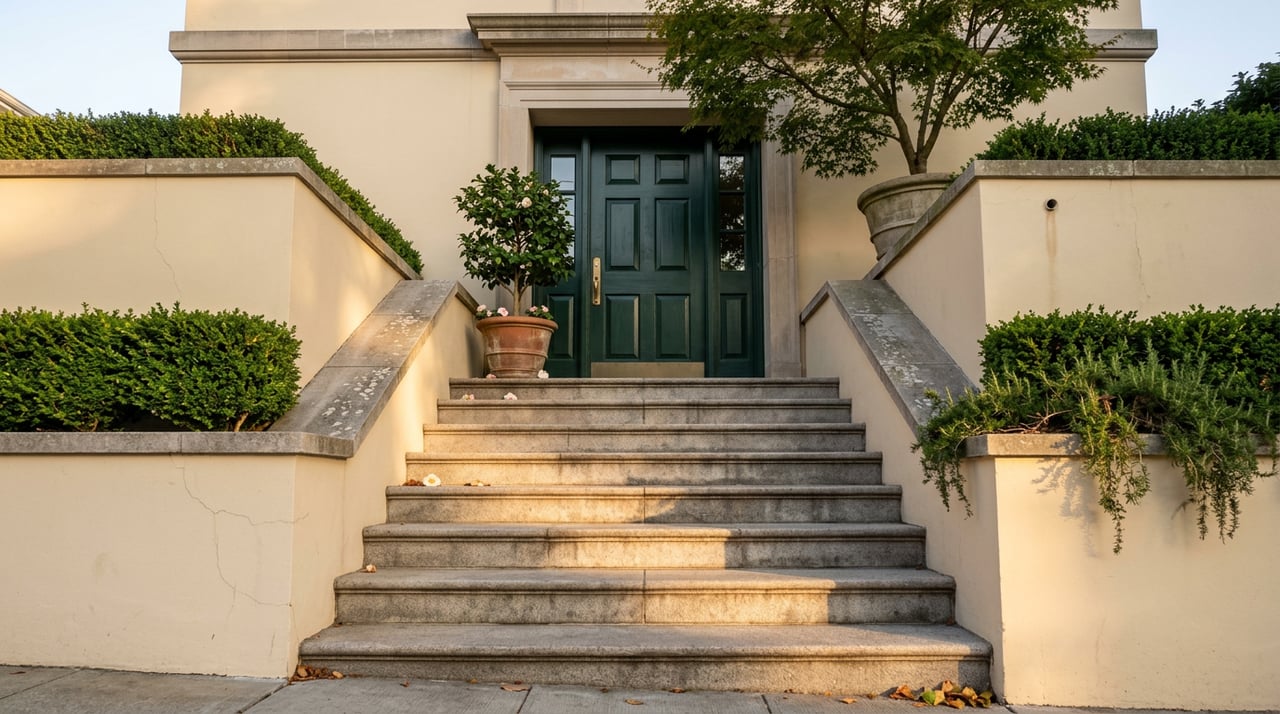
Saturday morning at Alta Plaza Park starts the same way it has for decades: dogs loop the southeast corner off leash, a handful of regulars claim the three tennis courts before anyone else is awake enough to want them, and by ten the Donor Circle bench at the top of the grand staircase has someone sitting on it with coffee, doing nothing but looking at the bay. It feels like public infrastructure running on autopilot, the kind of amenity a hilltop neighborhood just gets to have.
It isn't running on autopilot. Right now, the playground at the center of that park is mid-renovation, and the money paying for it did not come only from the city.
The park's budget has two names on it
San Francisco Recreation and Parks manages more than 230 parks, playgrounds, and open spaces citywide, and the department is candid about how it allocates deferred maintenance dollars: it focuses resources on the sites judged most in need, based on safety and equipment age, not on which neighborhood is asking loudest. That matters here, because Alta Plaza's playground equipment isn't in crisis. It works. It's just tired. Under a strict triage model, a park like this waits its turn behind sites with actual safety flags.
It isn't waiting. This year, the Friedman Family Playground inside Alta Plaza is getting resurfaced and select equipment refreshed, and the nonprofit Friends of Alta Plaza Park is a direct funder of that work, not just a cheerleader for it. San Francisco Recreation and Parks secured roughly $600,000 in public funding for the project. Friends of Alta Plaza Park raised another $80,000 from neighbors specifically earmarked for play structure improvements. The city wrote the bigger check. The block wrote a real one too.
That second number is the part worth sitting with. Public parks departments don't typically ask homeowners to co-fund a resurfacing job. When a neighborhood group raises five figures on top of a six-figure city allocation, it's a signal about how this particular park gets prioritized inside a 230-park system: not automatically, and not for free.
This is not the first time neighbors have paid twice
Walk into the children's play area and you'll pass two low seating walls, one thirty feet long and one fifty, both covered in handmade tile mosaics. Friends of Alta Plaza Park commissioned artist Aileen Barr to build them during an earlier playground renovation, and the design integrates donor tiles bearing the names of the community members who funded that round. If you've ever wondered why a public park bench has names pressed into it, that's why. Someone in the neighborhood paid for it and the park remembers.
The tennis courts have the same backstory in miniature. A design firm retained by Friends of Alta Plaza Park to build a long-range master plan for the park noted plainly that "in recent years, with the support of neighbors, a new playground was installed and tennis courts were upgraded." Even the park's plantings carry a neighbor-versus-city tension: when the city's water utility swapped hillside turf grass for no-mow groundcover to cut irrigation costs, the change proved unpopular enough that it became the reason Friends of Alta Plaza Park commissioned a full master planning process in the first place, covering drainage, pathways, and planting.
None of this is a complaint about city government. It's a description of how a specific 12-acre park at the top of Pacific Heights actually functions: baseline maintenance from the city, and everything above baseline, the mosaic, the tennis upgrades, this year's playground refresh, funded in meaningful part by people who live within walking distance and decided the wait wasn't worth it.
What you can actually do there right now
If you haven't used the park in a while, a few practical things are worth knowing before you show up expecting the layout you remember.
- Tennis and pickleball courts. Alta Plaza has three courts, first-come-first-served by default, but you can reserve one in advance through SF Rec and Park's online system. Reservations for most courts open at 8:00 a.m., seven calendar days before the date you want. You can't book more than one court per day or more than three in a calendar week, and a reserved court left empty for fifteen minutes past its start time opens back up to walk-up play.
- The dog play area. Off-leash access is limited to the sloped grass and paved pathways in the park's southeast corner. Elsewhere in the park, including the path that runs past the renovated play area and the courts toward Scott Street, dogs need to stay on leash.
- Picnic tables. There are two reservable picnic areas, one north of the playground with two eight-foot tables and one south with a single table, bookable in morning and afternoon blocks. Alcohol and barbecues aren't allowed, and the north area caps out at fifty people.
None of this is complicated, but it's also not obvious from the sidewalk, and the rules exist because a park this small gets heavy, overlapping use from tennis players, dog owners, and families in the same two-hour window most weekend mornings.
The staircase has outlasted more than the turf debate
The grand staircase that climbs the park's southern slope from Clay and Pierce Streets predates most of the current renovation drama by more than a century. Alta Plaza's roughly 12 acres were purchased by the city in 1877, sat mostly untouched for two decades, and were then graded, planted with Monterey cypress, and terraced under Park Superintendent John McLaren, working from a design by Rudolph Ulrich. Like nearby Lafayette Park, Alta Plaza served as a refuge for residents displaced after the 1906 earthquake and fire.
The staircase itself has a stranger claim to fame. It's the set of steps four vehicles drove down in the 1972 film "What's Up, Doc?", and the chips left in the concrete from that stunt were still visible to visitors as recently as 2022. The same staircase shows up in Francis Ford Coppola's "The Conversation." Whether that trivia changes your Saturday is beside the point. It's the kind of detail that makes a park feel like it belongs to a specific place rather than being interchangeable green space, and it's been true long before any tile mosaic or funding campaign entered the picture.
Where the morning usually ends
Most park regulars don't stay inside the fence for the whole visit. The walk down toward Fillmore Street is short, and it's where the coffee and the picnic supplies actually come from. Jane on Fillmore is the standard stop for a pastry and a coffee on the way up or down the hill, and Mollie Stone's on the Fillmore corridor is the closest full grocery if you're assembling a picnic instead of buying one. If you're coming from the Pine Street side of the park, Bay Bread Boulangerie near Pine and Fillmore has been a fixture for the same reason: it's close enough to grab something and still make it back to the grass before the good bench is taken.
None of these businesses have anything to do with the playground renovation. They're just the other half of what a normal Saturday at Alta Plaza actually looks like, and leaving them out would make this a park story instead of a neighborhood one.
What to watch for this year
If you use the playground regularly, expect the resurfacing and equipment work to be visible and, at points, disruptive to normal access, since the project is active in 2026. Friends of Alta Plaza Park has been running its fundraising campaign publicly, which means updates on scope and timing are more likely to show up through the nonprofit's own channels than through a city press release. If your household uses that play area on a set schedule, it's worth checking before you plan around it.
The larger point holds regardless of the exact week the resurfacing wraps. Alta Plaza works as well as it does because people who live around it have been willing to put money behind the parts the city's baseline budget doesn't stretch to cover. That's not a complaint about San Francisco Recreation and Parks. It's just the actual mechanism behind a park that a lot of people assume runs on autopilot. It doesn't. It runs on a fund named after the neighbors who show up.
If you're weighing what it means to put down roots in a neighborhood where residents fund their own park upgrades, that's exactly the kind of texture worth understanding before you buy. Amanda Jones Advisory works block by block across Pacific Heights and the rest of San Francisco, and we're always glad to talk through what daily life actually looks like in a neighborhood before you make it yours. Book a private consultation whenever you're ready.